Hope for Democracy

America! We, the people are in charge.

Depressed about government mired in hyperpartisan dysfunction? Let's build something better. We don't need to wait for a corrupt system to reform itself. Citizens have the power to organize across the political divide — using nonpartisan, citizen-based alternatives — and take back real decision-making power.

See How It Works ↓
Cross-partisan by design — 50/50 balanced funding, team, and membership. Both sides in the room. Always.

A System Designed to Fail Us

Here's what most people feel but can't quite name: the problem isn't "the other side." The problem is a two-party system fueled by money that rewards extremism and punishes compromise. The incentives are broken — not the people.

The results are predictable:

Hyperpolarization Media dysfunction Deep cynicism Elite capture Near-zero citizen influence on policy

Research confirms what we already sense: average citizens have almost no measurable impact on what government actually does. The system isn't broken by accident. It's working exactly as the incentives dictate. But when our agreements for self-governance are failing us, we can make new ones.

George Washington Warned Us about Parties

We revere the architects of American democracy. But we've forgotten their sharpest warning: political parties would destroy the republic.

Founders designed a system built on debate, compromise, and citizen deliberation — and they expected future generations to keep innovating. Instead, we got exactly the disease they feared most.

The good news? The American people do value innovation. We've demonstrated creative brilliance, resolve, and perseverance, time and time again. It's time we turn that attention to how we self-govern.

"The alternate domination of one faction over another … is itself a frightful despotism."

— George Washington

"A division of the republic into two great parties … is to be dreaded as the greatest political evil."

— John Adams

"Political parties are the 'most fatal disease' of popular governments."

— Alexander Hamilton

Proof It Works: Ordinary Citizens, Extraordinary Results

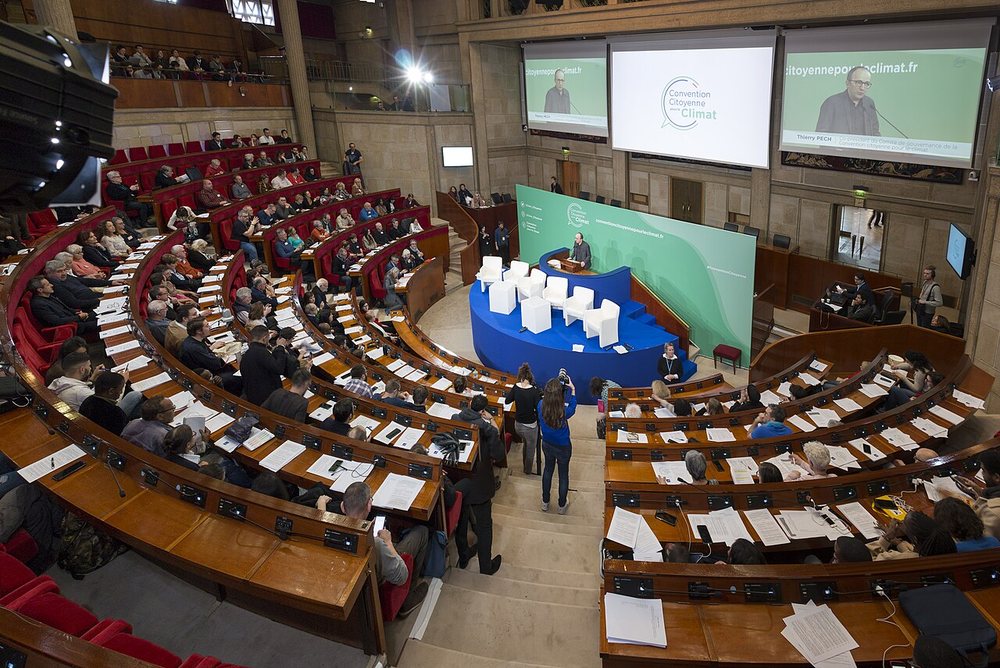
What happens when you give real citizens real power over real decisions? Ireland tried it — and the results are worth examining.

Ireland's Citizens' Assembly on Abortion

2016–2018 · One of the most divisive issues in Irish society

99 randomly selected citizens — a cross-section of Irish society across age, gender, geography, and belief — spent five weekends hearing from medical experts, legal scholars, and women with lived experience.

Many arrived undecided or conservative. Through structured deliberation, they reached a recommendation far bolder than any politician had dared propose.

The national referendum that followed passed in a landslide — and the process was remarkably peaceful. The assembly had already done the hard work of reconciliation.

  • 99 randomly selected citizens
  • Diverse on politics, age, gender, race, income
  • Met over 5 weekends
  • Reached 87% unity on their decision
  • The national vote followed … 66% voted Yes

What We're Building

Hope for Democracy runs three interlocking efforts — each designed to support the others.

1

Spark the Conversation

Most Americans have never considered democratic alternatives. We change that — through media and social media, storytelling, and public dialogue.

2

Foster Demonstrations of Alternatives

Fund and support hands-on experiences with citizen assemblies, deliberative polling, and other proven approaches, and amplify their potential.

3

Pull the Lever

Build cross-partisan voting coalitions in swing districts that give citizens real power over candidates.

How a Few Hundred Citizens Can Change Everything

It sounds impossible. But it's happened before — and the math is simpler than you think.

<1.5%
of voters

That's all the NRA had as members at its peak influence. They stopped gun control for decades — even when 70% of Americans supported it. Their secret? Members spanned both parties and voted as a disciplined bloc. A tiny cross-partisan group overwhelmed the majority, when candidates feared their wrath.

We're applying the same arithmetic to a different end. In competitive districts decided by razor-thin margins, a small coalition of citizens — Republican, Democrat, and Independent — who commit to voting together can hold the balance of power.

Federal — Arizona 1st District
3,200vote margin
~1,100citizens to shift it

Held by just 3,200 votes. A cross-partisan coalition of ~1,100 organized citizens would have held the balance of power.

State — Pennsylvania HD-72
1,001vote margin
~350citizens to shift it

The race that decided control of the PA House. Just ~350 citizens could have swung the outcome.

The deal is simple: citizens who've witnessed or participated in a legitimate deliberative process commit to vote together for whichever candidate pledges to follow the district's voice, giving teeth to deliberative processses that are operated independently of the partisan morass. Candidates who refuse lose organized votes. Those who commit gain cross-partisan support.

And while "election reform" has never reached the table as a top reform, we believe this is a very different story — far more revolutionary and visceral than advocating within the system for tweaks of the system. This is about the people taking back their power.

Mechanical Advantage: How a small margin moves the whole district U.S. House hemicycle showing the 2-vote margin

A Virtuous Cycle

Each success makes the next one easier.

Hope Restored Spark the Conversation Foster Alternatives Pull the Lever sparks curiosity builds credibility proves it's possible Each win fuels the whole cycle

Conversation spreads awareness and creates demand for experiments. Experiments prove common ground is real, attracting people to the lever. The lever's impact — elected officials actually listening — proves change is possible.

That proof restores hope. Hope fuels more conversation. The cycle accelerates.

Donors and volunteers arrive. The network grows. And the idea that citizens can govern themselves stops being idealistic — and starts being obvious.

How We're Different

Most Americans fighting for change are pushing against a wall. Hard, necessary work — but the wall doesn't seem to move.

Hope for Democracy is opening a door, with a very different approach.

Approach Working within existing structures Working outside existing structures
Replace the decision-making system Citizen juries or assemblies commissioned by a city or county government
Hope for Democracy
Proof that better self-governance is possible. Citizens take their power back — by working across the political divide, outside the corrupt system.
Tweak the existing process (but keep fundamentals) Lobbying for elections reform — e.g. Citizens United, Electoral College, term limits Media campaigns or strategy convenings for better process — e.g. campaign finance, term limits
Better candidates, parties, and policies, within existing process
  • Campaigns, donations, and get out the vote efforts
  • Suing the government (using the court system as per the Constitution)
  • Civil disobedience (e.g. ICE protests)
  • Mass national rallies (e.g. No Kings)

Our highest vision: If enough Americans come to see that the current system is just one option — chosen by agreement, and replaceable by agreement — we believe a supermajority could demand something better. Not reform. Replacement — with deliberative democracy at the center of a new civic operating system.

Cross-Partisan by Structure, Not Slogan

Everything we do must be balanced across the political divide. The voting coalitions only have leverage if they span liberal and conservative — that's the entire mechanism. A coalition of only progressives has zero additional power; their votes are already locked in. The power comes from crossing the aisle.

So we don't just aspire to balance — we require it, structurally, at every level of the organization.

Funding

Every million capped at 50% from each side

Leadership

Actively recruiting a conservative co-Executive Director and bipartisan board members

Coalitions

Voting blocs must include balanced R, D, and Independent participation to have leverage

Every Experiment

Significant liberal + conservative participation in every initiative. Both sides, always.

Brian Burt, Founder of Hope for Democracy

Why I'm Doing This

I'm scared for my children. I look at the challenges ahead — climate, AI, institutional decay — and I see a political system that's not just failing, but accelerating toward failure.

But at MaestroConference, the company I founded and ran for 15 years, I got a glimpse of something. Some of our visionary facilitator customers were doing remarkable things — getting real people to real common ground. I've been turning it over ever since.

I've spent 25 years building systems that work at scale — at the Federal Reserve, at Charles Schwab, hosting millions of participants for the Obama Campaign, the White House, the World Bank, and hundreds of leading organizations.

Now I'm pursuing this 100%. I don't know that all of this will work. But I know it's worth putting all of my efforts towards.

But we need help.  If you share my belief that this effort is worth investing in, will you invest your time, money or resources?  And will you introduce us to other potential supporters?  

This movement will only success if people stand up for our democracy. Will you? How?  We'd love your support.

— Brian Burt, Founder

This Is Just the Beginning

We're raising seed funding and building a founding community. Here's how to take the next step.

Hear the Full Vision

Potential seed donors, please schedule a 30-minute conversation with Brian hear more about the plans, and get your questions answered.

Book a Call

Stay in the Loop

Get occasional updates as experiments launch and results come in.

Get Updates

Support the Work

This is 100% donor-funded. Every contribution — large or small — helps us build what democracy deserves.

Donate